OUR VISION
The Louis Armstrong Park Cultural Center
A joyous expression of sacred space, The Louis Armstrong Park Cultural Center (LAPCC) – seated in Louis Armstrong Park, is a transformational space celebrating the root culture of New Orleans and honors the sacrifices, achievements, and legacy of our ancestors. It is a place that recognizes our cultural past as an essential part of our cultural future. As it has been in the past, the Cultural Complex will be a center of joy that not only exemplifies our cultural identity but stands as a model of community development, social and economic empowerment, and advocacy.
The Cultural Complex is a home for our creatives who sew and bead to remind us of our stories. Those who cook the food and play the music that nourishes our souls. The ones who dance to keep the rhythm of our ancestors in their hearts. This place is a home for all the recording, visual and textile artists who show us the connections through their artforms. This is a space of resilience and resistance for the revolutionaries who give us a glimpse of a future worth fighting for. The Cultural Complex will be a place for residents, visitors, teachers, storytellers and most importantly, our youth to engage, learn and directly connect with the culture bearers of New Orleans. This is a space that aims to reflect the past, present, and future of socially and politically liberated black space in this city and across the world. Because Black Space Matters.


Interior view of Museum Space


Exterior view of the LAPCC
FLOOR PLANS
Ground Floor

The ground floor of the LAPCC is designed to accommodate a multitude of programs and uses. The primary outlay of the program breaks down into three components. The first Community Market and Performance space. Second, a community conference space, and lastly the cultural museum and repository.
Community Market and Performance Space
- Provide an active commercial marketplace for beta businesses to grow and build connections
- Utilize the existing performance space as an accessible venue for New Orleans cultural organizations
- Support the culinary arts through food venues on the ground floor
Community Conference Space
- Conference space that supports small to medium sized cultural organization conferences
- Open space as community classrooms
Cultural Museum and Repository
- Space dedicated to sharing the complex and rich history of New Orleans through the lens of indigenous communities.
- Open up the potential for a long term reconstruction or civil rights museum to activate the space
Second Floor

The second floor of the LAPCC makes space for the act of cultural maintenance. The space supports a community curated repository to hold the collective narratives and stories of New Orleans Cultural Communities. The second floor of the museum expands on the themes built throughout the space.
Repository
- Preserving the cultural legacy of the city as defined by the people of the city
- Providing a space curated by the culture bearers of New Orleans on display as determined by the community.
Museum
- Expanding the themes of the museum
Third Floor

The third floor of the LAPCC is dedicated to making and creating. This floor is wrapped with maker spaces and artists studios. Access to a supper club from the third floor over looks the processional space below.
Creative Spaces
- Maker spaces supporting New Orleans creative community
Supper Club
- A classic jazz supper club celebrating traditional New Orleans Jazz and cuisine
Fourth Floor

Fifth Floor


Market/Performance Narratives
- The first floor at the St Ann Street side of the Louis Armstrong Park Cultural Center will house movable market stalls where local vendors can sell goods and crafts.
- The market space converts back to a performance space for live performances on both the interior of the building and the exterior stage that the St Ann Street side of the building.
Creative Spaces Narratives
- Spaces for community members to create are distributed throughout the building on each level with rooms for dance studios, culinary classes, Mardi Gras Indian beading rooms, and various other maker spaces.
- The creative spaces are adjacent to display area so that work can be shared and a sense of community creation and collaboration is fostered.

Convention/Meeting Spaces
- On the Basin Street side of the first floor of the Louis Armstrong Park Cultural Center, meeting rooms are located as spaces to host events and meetings for local organizations as well as out of town conventions.
- Outside of the convention season, the meeting spaces can also be used to teach classes to youth to ensure that the culture is being passed down to future generations


Museum Narratives
- In the existing annex of the Louis Armstrong Park Cultural Center, the two-story exhibition spaces are transitioned to a museum that is connected to Congo Square by a processional promenade.
- The two levels of the museum space exhibit artwork and share stories that are specific to the history of New Orleans and Black culture.


The Morris FX Jeff Municipal Auditorium
On August 26, 2025, the City of New Orleans and Save Our Soul Coalition broke ground at Morris FX Jeff Municipal Auditorium in Louis Armstrong Park. The FEMA funded roof restoration has begun! This is a huge step forward 20+ years after Hurricane Katrina and failure of federal levees damaged the building.
The Morris FX Jeff Municipal Auditorium, built on top of the Sacred Ground of Congo Square, was initially built without regard for the nature of this sacred space. Over time, the Auditorium became a community gathering space for concerts, graduations, and other events where this beloved community could be free to express themselves fully.
The future of the Auditorium is rooted in the culture of the community we are fighting to preserve. The Auditorium’s design must be a representation of the indigenous culture and traditions of Black and Native American people. It must include venues that support those traditions and legacies and build the social, cultural, and economic frameworks to sustain them. This building will be a celebration of New Orleans Black Culture. The project will make resources available to our cultural bearers, educate the masses, and lift the community’s voices.
The Municipal Auditorium has played a vital role as a gathering place for generations of New Orleanians. It has been adapted to a wide variety of programs in order to fit the public life of our city. It was especially important in the era before the Superdome and the Smoothie King Arena were erected.
During community meetings, people remembered the musical history of the space. The Municipal Auditorium was an early venue for Jazz Fest, providing a familiar starting point for a festival that has since become a cultural touchstone for New Orleans. Legendary performers such as B.B. King, The Meters, and Nina Simone performed there during early festivals, with even more performing just outside in Congo Square.
The space also consistently served as a sports venue. Boxing, basketball, and even winter sports like ice skating and hockey took place in the Auditorium. Community members also looked back on the brief period when the Municipal Auditorium housed Harrah’s casino.
Much public memory around the space has to do with the Mardi Gras balls held there, as well as graduation ceremonies. These local events were essential pieces of the rhythm of local life. The Auditorium’s role as a venue for Mardi Gras balls was especially important, with many photos of revelry being recorded in the space.
This vibrant cultural history surrounded and filled the Municipal Auditorium since its construction. It holds a special place in the lives of New Orleans residents and this plan intends to advance that vision.

Louis Armstrong Park
Named for one of the city’s cultural icons, Louis Armstrong Park holds a particular significance to Black and American culture. The Park is the first set aside lands dedicated to the ritual, spiritual, cultural, and entrepreneurial gathering of enslaved Africans. On the 32 acres that encompass Louis Armstrong Park sit the remaining sacred ground of congo square in honor of our ancestors, Morris FX Jeff Municipal Auditorium named for the activist and leader of NORD from 1947-1986, and Mahalia Jackson Theatre in celebration of the Great Gospel singer. This Park is the psychic center of Indigenous, Tremé, New Orleans, and African-American Culture across North America.
Developing a Park plan that honors the resident experience and provides a unique opportunity for future economic growth will set the Park apart as an authentic cultural experience.
Essential to both the Cultural Center and the culturally activated moments around the Park is the design of space that acknowledges past inequities and builds solid economic pathways for the development and the cultural bearers supporting its growth.


Exterior views in
Louis Armstrong Park
Meeting the Challenge of Climate Change through Green Infrastructure Strategies: Stormwater
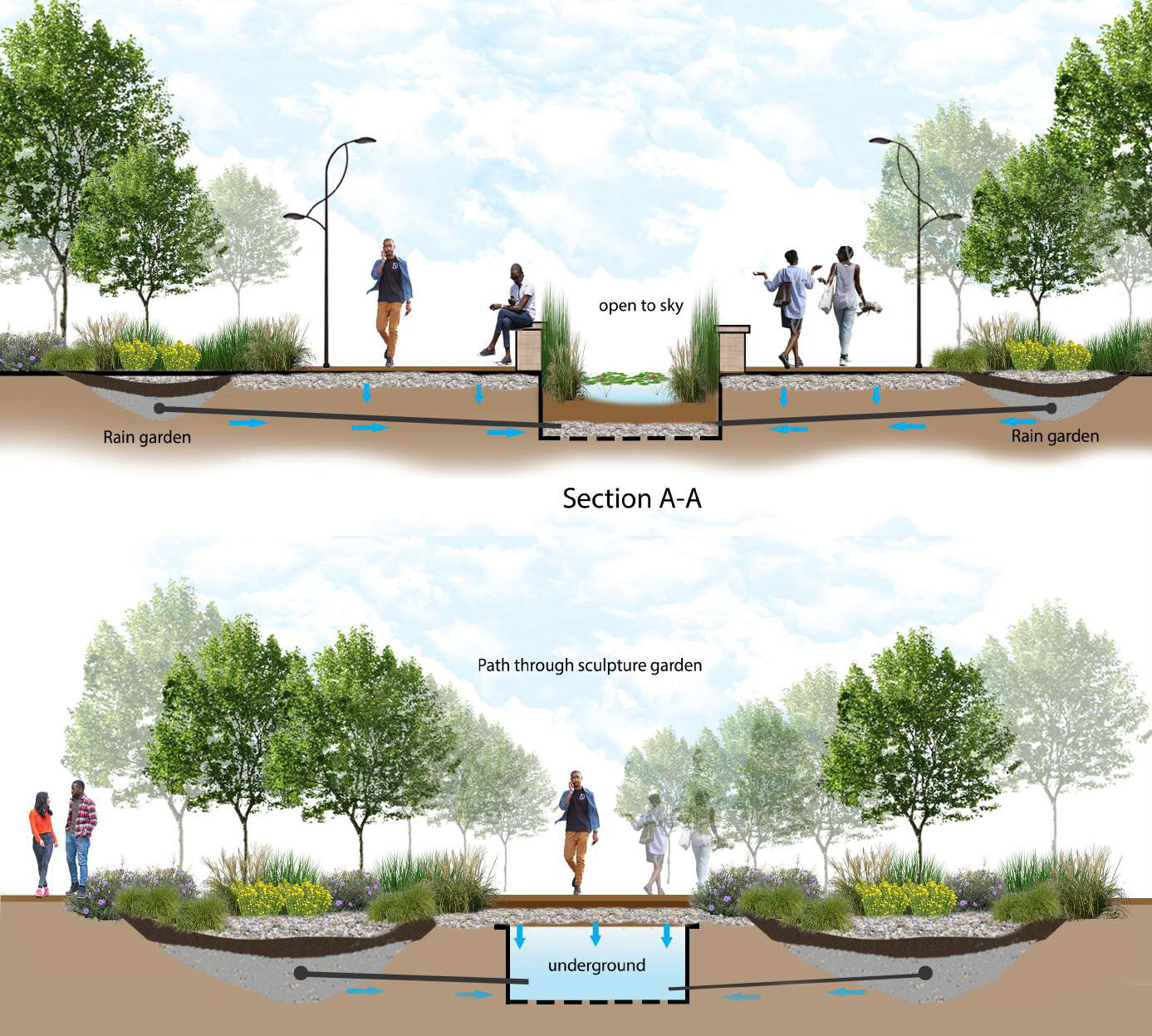
The Louis Armstrong Park re-design incorporates a series of rain gardens as stormwater interventions to the east of the Municipal Auditorium on the south side of the park through the proposed sculpture garden and for three of the blocks east of Dumaine Street to St. Phillips Street within the Park. An underground water storage channel is proposed to extend from Rampart to Villere under Dumaine Street in the Park and connect with a 1/3-acre rain garden along Villere Street. The Park drains flowing from Rampart to Villere Streets. The rain gardens capture storm water, prevent the water from going to adjacent streets to reduce flooding, and become a green infrastructure educational tool for the communities surrounding Louis Armstrong Park. All the rain gardens feed into the water features that are located under the main pedestrian pathways. The rain gardens plus the underground water storage channels will store up to 3 million gallons of water during major storm events and release the water back underground within 48 hours to help to reduce subsidence.
The water channel under Dumaine Street and under Henriette Delille Street in the Park will hold about 168,000 gallons, while the water storage under the winding connecting path through the rain gardens will hold an additional 177,000 gallons.
Inspired by the existing rain garden at the Treme’ Community Center, the rain garden on Villere Street will hold 224,000 gallons during a storm event for up to 48 hours. The remaining rain gardens throughout the Louis Armstrong Park will hold 2.431 million gallons of water allowing the water to eventually be absorbed back into the soil, slowing subsidence.
While the existing lagoon water feature in Louis Armstrong Park could probably hold similar quantities of water, estimating 2.6 million gallons, the system is not designed as green infrastructure and thus as a paved pool, adds to subsidence preventing water from returning to the soil. The current system lacks the dynamics to function even as a retention pond holding some water and slowly releasing water after a storm event. Rain gardens as green infrastructure offer multiple uses of the same spaces with trees and other plants, while managing stormwater and flooding beyond the boundaries of the Park.

Water Management
The Louis Armstrong Park re-design incorporates a series of rain gardens on the south side of the park along the sculpture garden. The rain gardens capture storm water, prevent the water from going to adjacent streets to reduce flooding, and become a green infrastructure educational tool for the community. All the rain gardens feed into the water features that are located in the main pedestrian pathways. These water features recreate the channels used to run through New Orleans.
For 249,915.4 sq ft area at 1.5 feet deep holding capacity, we can store 2,804,245 gallons of water for a 48 hour release period.